1. Why Video Endoscopic Inspection of Internal Welds Is Essential
Video endoscopic inspection of internal welds is now considered one of the most effective techniques for quickly verifying the quality of a welded joint, especially inside pipelines and industrial systems.
Industrial video endoscopy makes it possible to perform direct visual inspections without disassembly, providing an NDT (Non-Destructive Testing) method that reduces both downtime and costs while improving operational safety.
This type of inspection is widely used in sectors such as:
- Food & beverage plants
- Pharmaceutical and biotech industries
- Oil & gas and petrochemical sectors
- Energy, boilers, and heat exchangers
- Automotive, railway, and aerospace industries
In all these applications, a welding inspection video endoscope allows operators to identify internal anomalies that cannot be detected externally.
2. What a Video Endoscope Allows You to Evaluate in Internal Welds
An industrial pipe inspection endoscope makes it possible to closely examine several critical aspects of an internal weld:
- Weld bead continuity
- Root consistency and regularity
- Presence of visible porosity
- Surface irregularities or inconsistencies
- Micro-lines or signs of internal alteration
- Presence of foreign bodies or residues
- Overall condition of the welded surface
These elements are fundamental in weld quality control, especially in systems where cleanliness and internal pipe integrity are essential.
3. Importance of Color Accuracy in Video Endoscopic Inspection
During welding processes, surface color variations may appear due to different thermal conditions. For accurate evaluation, the video endoscope must:
- Reproduce colors faithfully
- Display even minimal tonal differences
- Automatically compensate brightness
- Eliminate reflections that may distort perception
- Maintain stable color rendering during movement
Accurate color visualization helps operators better interpret the condition of the weld joint and detect possible alterations.
4. Application of Video Endoscopes on Different Types of Welds
Internal welds may be produced using:
- TIG welding
- MIG/MAG welding
- Orbital welding
- Automatic or specialized welding processes
In all these cases, a video endoscope for internal weld inspection allows users to:
- Follow the weld bead along the entire pipe circumference
- Inspect fittings, bends, and hard-to-reach areas
- Verify uniformity, profiles, and color consistency
- Obtain photo and video documentation of the weld joint
This makes video endoscopy an extremely versatile solution for any industrial production environment.

5. Advantages of Video Endoscopic Weld Inspection
Using an industrial video endoscope for weld inspection offers numerous advantages:
- Non-destructive inspection (NDT)
- No significant production downtime
- Access to internal areas unreachable by other methods
- Immediate real-time evaluation
- Recordable and archivable documentation
- Reduced maintenance costs
6. Essential Features of a Video Endoscope for Weld Inspection
To achieve effective inspections, a professional instrument should include:
- Small-diameter probes (4.0 mm / 6.5 mm)
- Lengths suitable for the configuration of the system
- 4-way articulating tip
- Dual front and side camera system
- Optimized depth of field
- Adjustable anti-reflective LED illumination
- Fast and stable white balance
- High-resolution monitor
- Photo and video recording
- HDMI, USB-C, and Wi-Fi connectivity
- Robust construction with IP67 certification
These features allow precise, reliable, and repeatable weld inspections.
7. LHC COBB Fibre Ottiche: the Ideal Video Endoscope for Internal Weld Inspection
(Main keyword: LHC video endoscope – highly relevant for SEO)
The LHC dual-camera video endoscope by COBB Fibre Ottiche is specifically designed for professional inspection of internal welds inside pipelines.
Dual 0°/90° Camera System
- Front view for advancing through the pipe
- Side view dedicated to weld bead analysis
- Fast switching between the two views
- Split-screen option for simultaneous visualization
Advanced Articulation
- 4-way articulating tip
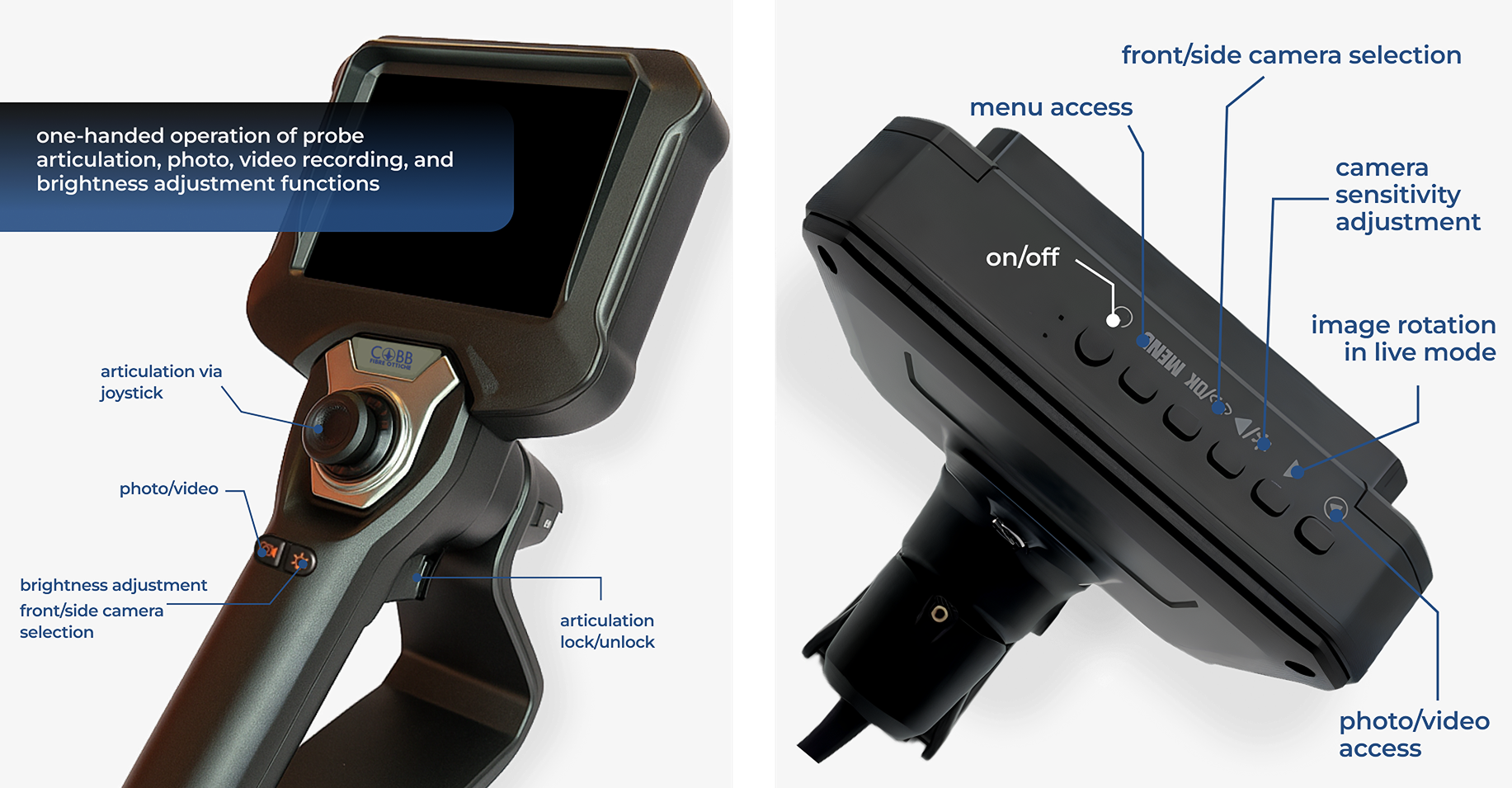
- Precise joystick control
- Optimal access to bends, T-joints, fittings, and difficult areas
Diameters and Lengths
- Available in 4.0 mm and 6.5 mm versions
- Extended versions with lengths up to 10 meters
- Stainless steel sheath with IP67 protection
Image Quality and Color Accuracy
- Ultra-fast automatic white balance
- Adjustable anti-reflective LED illumination
- High-definition 5” HD monitor
Documentation and Connectivity
- JPEG photo and MP4 video recording
- HDMI, USB-C, and integrated Wi-Fi
- One-handed operation and control management
The LHC system guarantees precise and detailed internal inspections, perfectly suited to the needs of professionals who must evaluate internal welds across any industrial sector.
⸻
8. Conclusion
Video endoscopy for internal weld inspection is now an essential tool for ensuring quality, safety, and reliability in industrial systems.
The COBB Fibre Ottiche LHC video endoscope, featuring dual-camera technology and advanced articulation, represents one of the most complete and high-performance solutions available on the market for internal visual weld inspection.
DISCOVER THE ARTICLE